HOW TO PREVENT AND FIX CPO COLOR REVERSION IN PALM OIL REFINERIES
1. The Challenge of Color Reversion in Refined Palm Oil
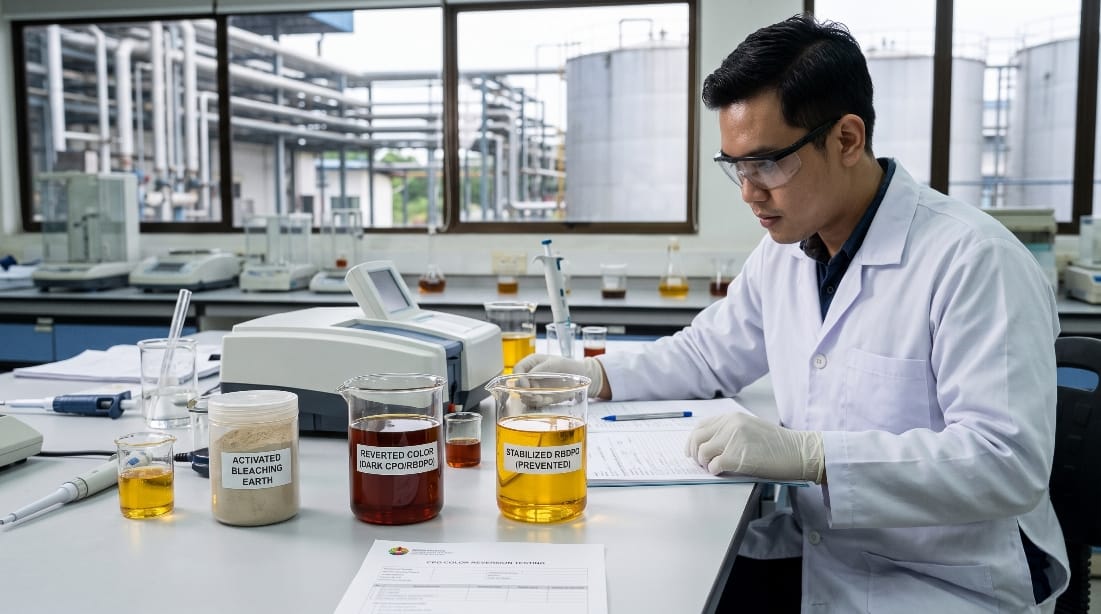
In the palm oil refining industry, achieving a bright specification for Refined Bleached Deodorized Palm Oil (RBDPO) is a primary target. This clarity is a strict standard across global markets. One of the most persistent technical headaches for plant managers and quality control teams is CPO color reversion – a phenomenon where fully refined oil unexpectedly darkens during storage in tanks or transit in vessels.
Furthermore, color reversion not only compromises visual quality and leads to customer rejections at destination ports, but it also signals underlying oxidative instability. Understanding why refined oil darkens after processing is the first step toward implementing targeted chemical and mechanical safeguards.
2. Root Causes of CPO Color Reversion
Three distinct mechanisms primarily drive CPO color reversion that occur during the pre-treatment and bleaching stages:
- Residual Chlorophyll (Thermostable Green Pigments): Unlike beta-carotene (red pigment) which breaks down thermally under high heat in the deodorizer (240°C–265°C), chlorophyll is heat-stable. Therefore, the bleaching earth must thoroughly absorb these pigments at the bleacher, it survives deodorization intact and acts as a photo-oxidation catalyst in storage tanks, causing the oil to acquire a dull, brownish-green tint over time.
- Pro-Oxidant Heavy Metals (Iron Fe & Copper Cu): Trace concentrations of heavy metals act as potent catalysts that decompose hydroperoxides into secondary oxidation products (aldehydes and ketones). These compounds form chromophoric complexes during storage, driving rapid color degradation.
- Secondary Oxidation Products (Low DOBI Crude Oil): Crude Palm Oil with low Deterioration of Bleachability Index (DOBI < 2.0) contains elevated levels of conjugated dienes and oxidized fatty acids. If bleaching conditions are inadequate, these oxidized precursors desorb back into the oil stream and recombine after cooling.
3. Impurity Behavior Matrix: Bleacher vs. Deodorizer
| Impurity Type | Bleacher Stage Action | Deodorizer Stage Action | Impact on Color Reversion |
| Chlorophyll (Green) | Must be 100% adsorbed by Bleaching Earth | Not thermally degraded (Thermostable) | HIGH RISK — Primary cause of post-refining darkening |
| Beta-Carotene (Red) | Partially adsorbed physically | Thermally broken down (Thermal Bleaching) | LOW RISK — Easily removed in deodorizer |
| Heavy Metals (Fe, Cu) | Bound & precipitated by acid + Bleaching Earth | Inert under steam stripping | HIGH RISK — Catalyzes oxidative color formation |
4. Operational Solutions for Palm Oil Refineries
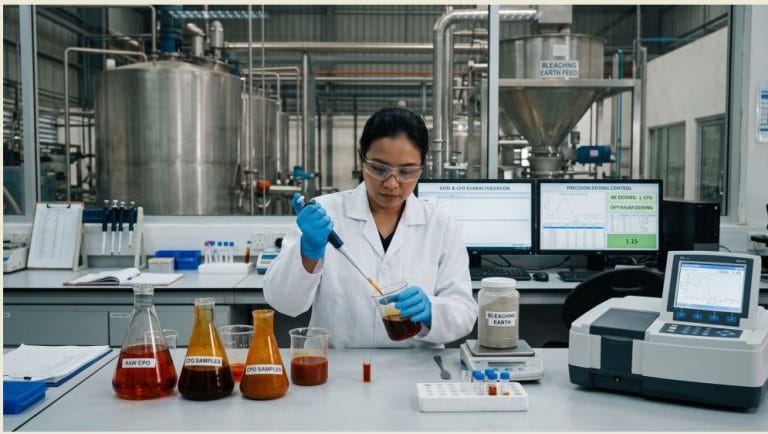
A. Optimize Acid Degumming Synergy: Ensure adequate dosing of food-grade phosphoric acid (0.02%–0.06%) or citric acid prior to bleaching earth addition. Acid degumming converts non-hydratable phosphatides into hydratable forms and precipitates heavy metal ions so that bleaching earth can capture them efficiently.
B. Lock In Optimal Bleaching Process Parameters: Maintain bleacher temperature strictly between 90°C and 105°C under full vacuum (50–70 mmHg). Ensure retention time is held between 30 and 40 minutes. Consequently under-retention leaves un adsorbed pigments, while over-retention causes thermal oxidation of unsaturated fatty acids.
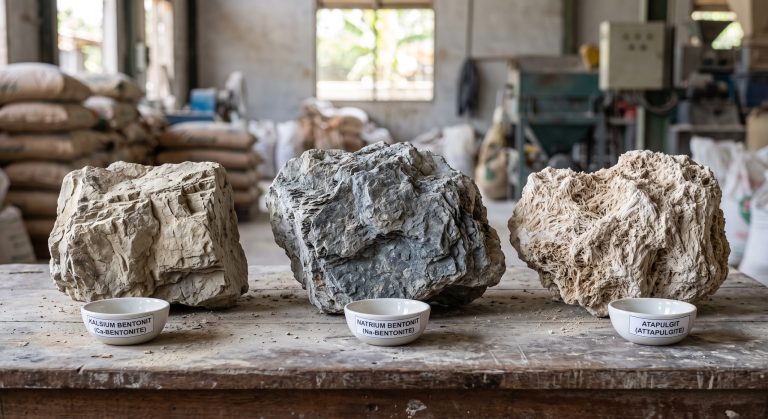
C. Switch to High-Absorption Activated Bleaching Earth (Terram): Using raw or under-activated natural clay fails to capture stubborn chlorophyll micro-pigments. Terram Activated Bleaching Earth undergoes precision acid activation, yielding a surface area of 250–320 m²/g. This provides superior pore volume specifically engineered to trap chlorophyll and heavy metals permanently, preventing desorption and guaranteeing color stability throughout storage and shipment.
5. Conclusion & Actionable Next Steps
CPO color reversion is a solvable challenge. Operators must execute precision tweaking of acid degumming and maintain tight bleacher operational windows. Furthermore, deploying high-performance activated bleaching clay like Terram helps eliminate color darkening. Ultimately, these steps safeguard product quality and protect downstream margins.
| REQUEST FREE TERRAM BLEACHING EARTH SAMPLES FOR YOUR REFINERY Contact PT. Dwi Karya Bentonit Indonesia for technical consultation & dosage testing: Mobile / WhatsApp: +62 81399143003 | Email: [email protected] | Web: www.terramchemical.com |