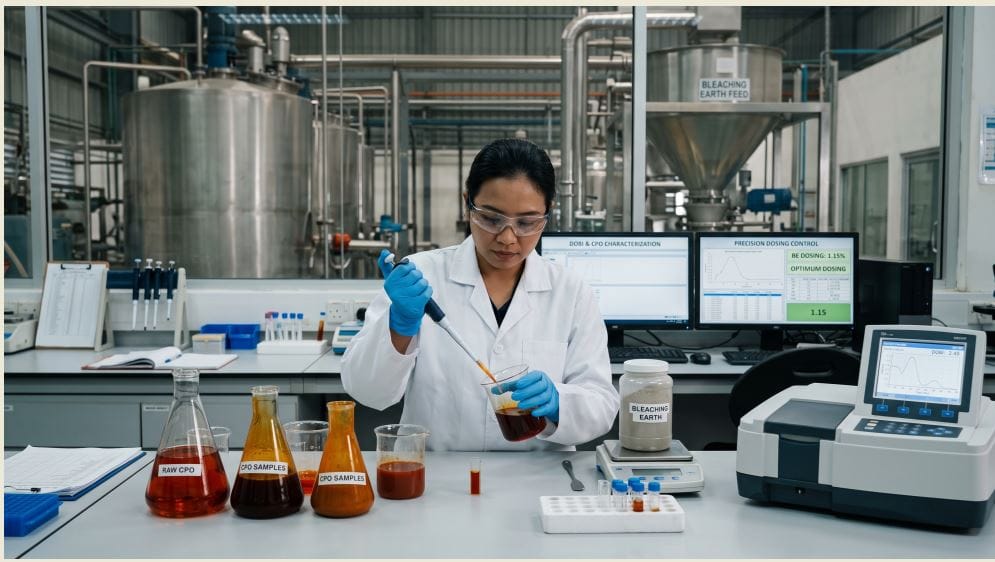
Mastering DOBI and Raw CPO Characterization for Precision Bleaching Earth Dosing
In modern physical palm oil refining, determining the precise dobi cpo bleaching earth dosage set-point is the single most critical step to prevent chemical waste and safeguard oil quality. Crude Palm Oil (CPO) is an organic raw material that inherently fluctuates in quality due to fresh fruit bunch (FFB) ripeness, harvesting conditions, and storage duration. Consequently, applying a static, one-size-fits-all bleaching earth dosage rate inevitably leads to costly over-dosing on premium feedstocks or dangerous under-dosing on degraded CPO. By establishing a rigorous analytical protocol based on Deterioration of Bleachability Index (DOBI) and secondary oxidation absorbance, refinery managers can systematically optimize clay consumption and protect their operational margin.
Understanding the DOBI Mathematical Index and UV-Vis Absorbance
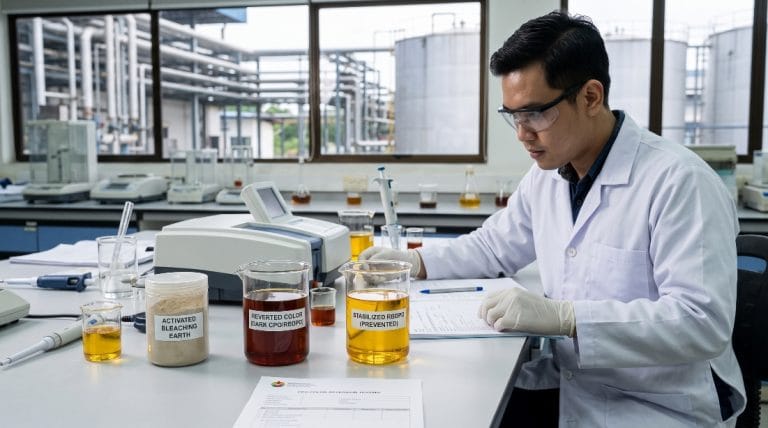
The Deterioration of Bleachability Index (DOBI) serves as an indispensable spectrophotometric indicator of CPO refining ease. Mathematically, DOBI represents the numerical ratio of UV-Vis absorbance measured at 446 nm divided by absorbance measured at 269 nm:
DOBI = Absorbance at 446 nm (Carotenoids) / Absorbance at 269 nm (Secondary Oxidation)
The numerator at 446 nm quantifies the concentration of natural carotene pigments (alpha- and beta-carotene), which typically range from 500 to 700 ppm in fresh palm oil. Conversely, the denominator at 269 nm measures the accumulation of secondary oxidation products, including conjugated dienes, unsaturated ketones, and volatile aldehydes. Fresh, high-grade fruit produces CPO with a high DOBI value (exceeding 2.93), indicating intact carotenes and minimal secondary oxidation. Conversely, poor-quality fruit or prolonged thermal exposure generates low DOBI values (below 2.30), signifying severe oxidative degradation that strongly resists color removal.
Establishing CPO Quality Tiers and DOBI CPO Bleaching Earth Dosage Set-Points
To eliminate trial-and-error operator adjustments, refineries should establish an automated dosing matrix linking incoming feed quality to PLC weighing scales. The following table outlines the industry-standard correlation between feed parameters and recommended baseline dosages:
| CPO Grade | DOBI Range | FFA Level (%) | BE Dosage (% w/w) | Operational Risk & Strategy |
| High Grade | > 2.93 (to 3.24) | < 4.0% | 0.6% – 0.8% | Highly bleach-active. High risk of over-dosing if baseline is not reduced. |
| Medium Grade | 2.31 – 2.92 | 4.0% – 4.5% | 0.9% – 1.1% | Standard refinery processing. Excellent bleaching kinetics. |
| Low Grade | 1.68 – 2.30 | > 4.5% | 1.2% – 1.5% | High secondary oxidation. Requires high specific surface area clay. |
| Very Poor / Waste | < 1.68 | > 5.5% | > 1.5% (to 2.5%) | Severe color reversion risk. Feed blending required prior to bleaching. |
The Pitfalls of Feed Blending and Real-Time Analytical Control
Many refinery managers attempt to manage low-DOBI CPO by blending it with high-grade stocks in storage tanks. While mathematical blending elevates the average DOBI value on paper, kinetic studies reveal that secondary oxidation products from the degraded fraction remain active. These oxidized dienes continue to compete for active adsorption sites on the clay surface, which can cause unexpected off-spec color in the final RBDPO. Therefore, real-time spectrophotometric testing must dictate the automated PLC dosing rate for every batch, ensuring precise clay injection without wasteful over-dosing.
Are you looking to optimize your plant’s CPO feed dosing matrix? Contact Terram Chemical to request high-adsorption activated bleaching earth samples tailored to your specific DOBI feedstock profile.