Safe-Food Contaminant Mitigation: Controlling 3-MCPD and Glycidyl Esters in Palm Oil Refining
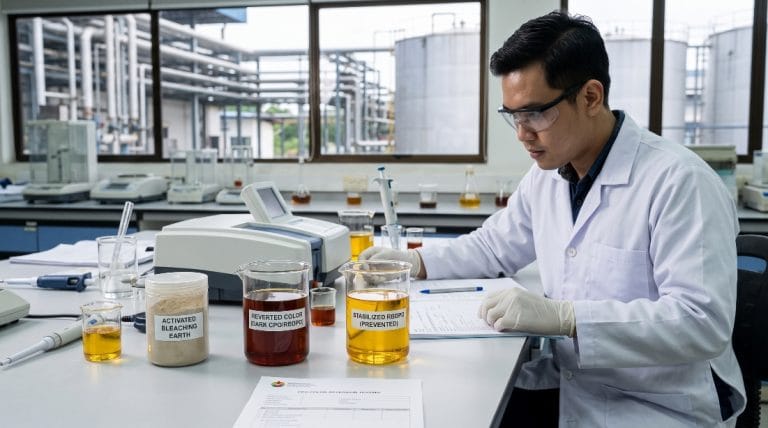
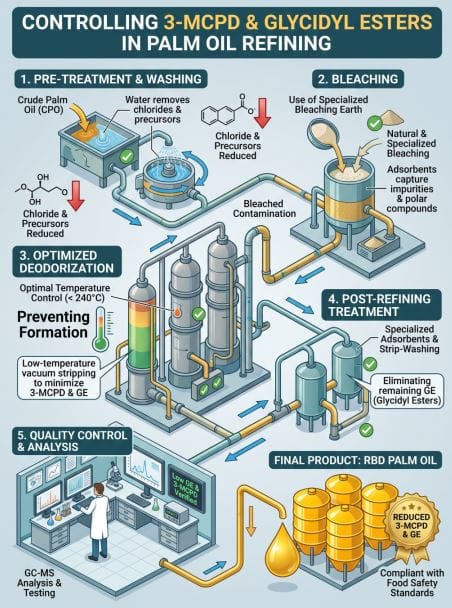
Modern edible oil refining is no longer evaluated solely on cost and physical clarity; food safety compliance is now equally mandatory. International regulatory bodies, such as the European Food Safety Authority (EFSA), enforce strict maximum thresholds for process contaminants, setting a 2.5 ppm cap on 3-monochloropropane-1,2-diol esters (3-MCPDE) and 1.0 ppm on Glycidyl Esters (GE). Selecting the correct 3-mcpd glycidyl esters bleaching earth grade during degumming and bleaching is crucial to prevent precursor formation during high-temperature deodorization.
The Catalytic Formation Mechanism of 3-MCPDE and GE
Process contaminants form when specific chemical precursors undergo thermal degradation at temperatures exceeding 200°C. Chlorinated compounds (such as organochlorines and inorganic salts) react with acylglycerols to yield 3-MCPD esters. Meanwhile, diacylglycerols (DAG) thermally intramolecularly rearrange into Glycidyl Esters. Highly acidic bleaching earth clays, possessing strong surface Lewis and Brønsted acid sites, act as active catalysts that accelerate precursor formation when oil is subsequently heated in the deodorizer.
Comparing Strongly Acidic vs Neutral Bleaching Clays
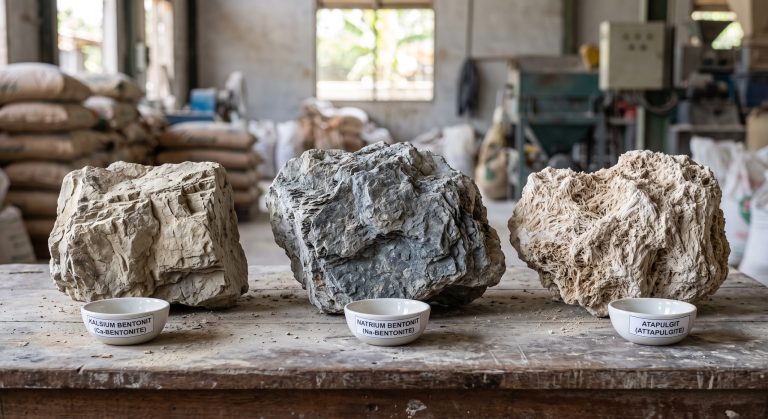
Refineries producing export-grade oil must carefully select their clay activation type. The table below compares the contaminant formation rates associated with different bleaching earth activation levels:
| Bleaching Earth Type | Surface Acidity (pH) | 3-MCPD Level (ppm) | GE Level (mg/kg) & Suitability |
| Strongly Acid-Activated | pH 2.2 – 3.0 | 1.99 – 2.80 ppm | Exceeds EU limits. High catalytic precursor activation. |
| Weakly Acid-Activated | pH 3.5 – 4.5 | 1.33 – 1.60 ppm | Fully compliant (< 2.5 ppm). Excellent balance of dosage & safety. |
| Natural / Neutral Clay | pH 5.5 – 7.0 | < 1.10 ppm | < 0.50 mg/kg. Superior food safety; requires specific surface area optimization. |
Synergistic Acid Degumming and Deodorization Temperature Control
Contaminant mitigation requires a holistic approach across both pre-treatment and deodorization. During degumming, injecting 0.05% to 0.06% food-grade phosphoric acid (H3PO4) effectively chelates inorganic chloride donors and Non-Hydratable Phosphatides (NHP). Furthermore, capping deodorization temperatures at 240°C–245°C while extending residence time suppresses GE formation below 0.50 mg/kg without compromising FFA stripping efficiency.
Exporting refined palm oil to regulated markets? Explore Terram Low-Acidity & Neutral Bleaching Earth Solutions designed specifically for 3-MCPD and GE compliance.