Optimizing Bleacher-Deodorizer Synergy IN PALM OIL REFINING
A frequent operational mistake in physical palm oil refining is forcing the bleacher unit to achieve the final light-red color specification entirely on its own. In a well-designed physical refinery, color reduction is accomplished through a dual-mechanism synergy between chemical adsorption in the bleacher and thermal degradation in the deodorizer. Understanding the clear distinction between thermal bleaching vs chemical adsorption palm oil processing allows operators to avoid over-bleaching Degummed Bleached Palm Oil (DBPO), thereby saving significant quantities of activated bleaching earth.
Mechanistic Separation: Thermostable vs Thermolabile Impurities
The key to optimizing bleacher loading lies in understanding how different oil impurities respond to heat versus active porous clay surfaces. The table below details the precise behavior of major CPO impurities across both refining units:
| CPO Impurity Component | Bleacher Behavior (90°C – 105°C) | Deodorizer Behavior (240°C – 265°C) |
| Beta-Carotene (Red Pigment) | Partial surface adsorption onto clay pores. | Dominant thermal degradation into volatile, colorless compounds. |
| Chlorophyll (Green Pigment) | Total adsorption onto active clay sites (Mandatory). | Thermostable. Does NOT break down; causes green/gray color reversion if unremoved. |
| Pro-Oxidant Metals (Fe, Cu) | Chelated by acid and adsorbed onto clay pores. | Non-volatile. Remains in oil and accelerates oxidation if unremoved. |
| Peroxide Value (PV) | Decomposed and adsorbed on active acid sites. | Completely thermally decomposed into volatile acids and aldehydes. |
Why Forcing Red Color Reduction in the Bleacher Wastes Money
Beta-carotene is thermolabile. When subjected to deodorization temperatures between 240°C and 265°C under high vacuum (2 to 3 mmHg), the conjugated double-bond structure of carotene undergoes thermal cleavage into colorless volatile fragments. Consequently, forcing DBPO red color down to 1.5 Red in the bleacher requires an exponential increase in clay dosage. Instead, maintaining an intermediate DBPO red color set-point (e.g., 2.4 to 2.6 Red) allows thermal bleaching in the deodorizer to complete the pigment breakdown naturally, reducing clay consumption by up to 30%.
The Critical Role of Chlorophyll and Heavy Metal Removal
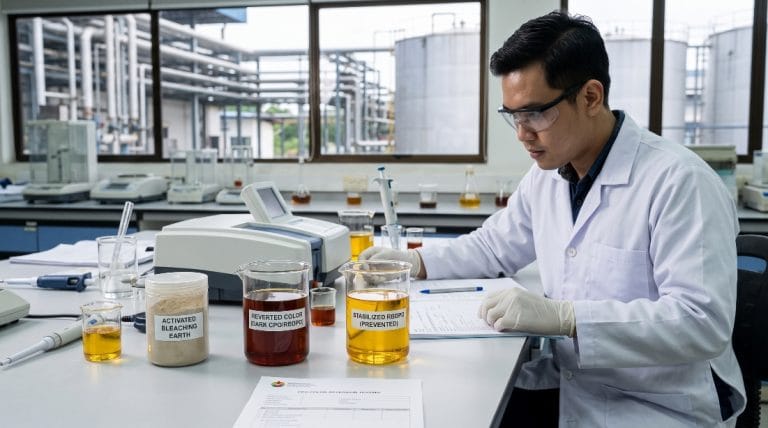
Unlike beta-carotene, chlorophyll is thermostable. If chlorophyll passes through the Niagara filters into the deodorizer, high heat will not decompose it. Instead, residual chlorophyll imparts a dull, brownish-gray tint to the finished RBDPO and causes severe color reversion during storage. Furthermore, pro-oxidant heavy metals such as iron (Fe) and copper (Cu) are non-volatile. Therefore, the primary goal of activated bleaching earth in the bleacher is complete chlorophyll absorption and heavy metal chelation, leaving carotene reduction to thermal deodorization.
Ready to stop over-bleaching your DBPO? Learn how Terram High-Absorption Bleaching Earth targets thermostable chlorophyll and heavy metals while dramatically lowering total clay usage.